Welcome to Sequim & Port Angeles Real Estate, LLC
12 Apr
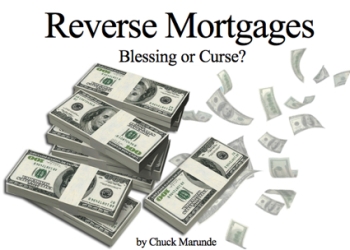
Reverse mortgages have been promoted in many commercials and by some famous Hollywood stars with whom senior citizens identify. Credible stars like Robert Wagner and Fred Thompson have touted reverse mortgages as wonderful financial solutions for senior citizens. These two venerable stars were certainly chosen for the great credibility they have with senior citizens. In the Fred Thompson advertisement on T.V., he says, “Reverse mortgages are helping seniors overcome financial worries and live the life of their dreams,” and the commercial goes on to state that they “don’t cost anything and you won’t lose anything.”
When anyone talks like this, we should all be put on alert. When debt is promoted as a way to freedom, be cautious. Reports of widows being evicted are now raising new concerns and expose reverse mortgages for what they really are–a very dangerous proposition for homeowners at any age. See Widows Sue Government and Reverse Mortgages Put Homeowners at Risk and Elderly and Reverse Mortgage Risk.
Ads are all over the Internet telling seniors how great reverse mortgages are, and using key phrases like, “quality of life,” or “your home forever,” and downplaying the risk. The idea is that if you own your home free and clear, you can get a mortgage on your home so you will receive an stream of income, and you will never have to move out of your home even if you can’t pay the loan back. The bank would only collect after you die. Sounds good, right?
Guess what? Widows are being evicted from their homes because of a little clause in the paperwork. If a surviving spouse’s signature is not on the mortgage, she or he will be evicted if they do not pay the entire loan off immediately upon the death of the first spouse. Wow! Where was that small print? Maybe it was in a Times Roman 6-point font tucked somewhere in the 17 page reverse mortgage documents.
Wisdom tells us to avoid debts and not to be a slave to the lender. (None of these rules apparently apply to the Federal government according to our politicians.) Reverse mortgages are another way to be in bondage to debt. There are logical financial and legal reasons why one spouse may not sign a reverse mortgage, but the risk of being in debt like this, and the risk of being evicted from your home when you are in your 80′s is simply not worth it. Before you sign the dotted line and get behind the idea of reverse mortgages as panaceas for seniors, I strongly recommend you seek sage advice.
Recently I spoke with a mortgage expert about reverse mortgages and this particular danger, and he said he thought this had been changed by law so that it was no longer possible to evict a spouse. You should talk with a mortgage expert on reverse mortgages. Buck Gieseke wrote an excellent article about reverse mortgages, and you can read that at Reverse Mortgages – Should I Get One?
UPDATE: Months later here we are in December of 2011, and a whole new barrage of T.V. commercials are hitting us daily, and guess who the stars are? Two of my favorite characters–Fred Thompson and Robert Wagner. Their sponsors have cast them in entirely new scripts and much more professional commercials than the earlier ones, but now Fred Thompson says, “You don’t even need to have an income or a good credit score.” Doesn’t that sound a bit like the sales hype that got us in the national mortgage disaster in the beginning? You might as well advertise, “Folks, there is such a thing as a free lunch. Come one, come all, and get your free lunch and free money, too.” That is how these commercials promote reverse mortgages, making it all sound so easy and wonderful and free.
One of my concerns about reverse mortgages is that they sell them with the same kind of hype that we know is full of it. There is no free lunch. Assuming they are no longer kicking widows out of houses for husbands who did get a reverse mortgage and died (yes, they did that, and told no one in advance it was possible), my question is what kind of nightmare awaits the elderly couple who get a reverse mortgage now? Remember what Shakespeare said, “Neither a borrower nor a lender be.” When you borrow money, especially most of the equity in your home, you become a slave to the creditor. There are implications to becoming a debtor, and none of them are good.
Having said this, I will say a reverse mortgage might possibly be a good move for an elderly couple who is in serious financial trouble, does not have enough money for medical bills, cannot afford the basic necessities of life, and this is their only possible source of funds. But the commercials are promoting ideas of living a life of luxury, traveling the world, enjoying the things you’ve always wanted to do, and so on. This really sounds like the kind of fraudulent advertising that was at the core of the mortgage crisis that crashed the real estate market. I’m just saying . . . now the same language is clothed in selling reverse mortgages. If you desperately need the money, fine, but if you can survive without, you might just avoid traps for the unwary, and there are plenty of them in the mortgage business that is so full of greed and fraudulent advertising. Reverses mortgages – beware.
Possibly Related Posts:
15 Oct
Initial news reports of the “sub-prime problem,†it seems, were only publicized recently. Suddenly we are in the middle of a financial meltdown of historic proportions: failures of AIG, Lehman Brothers, and Washington Mutual, despite a $700 Billion government bailout, and a fear in the market as hasn’t been experienced since the 1929 crash.
Explanations are complicated by irresponsible reporting by financial news networks, politicians seeking election, re-election, or who are just plain finger pointing, and the Administration. Are we over-complicating the problems and the solutions? What caused the problem and why did it go so far? Despite the far-reaching nature of any national issue, problems and solutions can frequently be analyzed and posed in very simple terms, and, although these analyses may need to expand with the increasing quantity and quality of the data, there are some basic issues. (more…)
Possibly Related Posts:
4 Jun
They say history repeats itself. The past twelve months are indicative that the same holds true for residential mortgage lending. The contents to follow depict what’s ahead and more accurately put, what’s already here.What does this mean to those in the market to purchase a new home or refinance their existing home mortgage? In short, it equals more documentation. Limited documentation of employment, income and assets has quickly become a thing of the past. Prospective borrowers should prepare for a more thorough loan process where documentation is no longer “optional†but in most cases required. The majority of the transactions being processed and closed in today’s changed market are “full documentation†loans (proof of income and assets required).
Now that most lenders are back to underwriting loans based on the secondary marketing guidelines, it is at the discretion of the agency purchasing the loan as opposed to the lender as to what documentation is or is not required (regardless of whether or not the loan servicing is retained). It is simply a matter of square peg, round hole; if it doesn’t fit the requirements, it’s not salable on the secondary market.
Documentation requirements are in place for three reasons. I touched on the first reason in the previous paragraph; certain documents are the requirement of the agency that buys the paper or IOU. The most competitive rates and programs are typically underwritten according to guidelines put forth by FNMA, FHLMC or GNMA (a.k.a. Fannie, Freddie & Ginnie). If a consumer wants a 30 year fixed rate mortgage, the necessary paper work will be the same from lender to lender regardless of being a bank or broker. What would be the point of asking for more paperwork than is actually needed?
The second reason is of federal proportions. On a national level, our government has a paternal interest in making sure that each federally related mortgage transaction meets certain standards of uniform disclosure (much of which is in place to limit fraud by consumer and lending institutions alike).
Finally, each state will have varying additional requirements as virtually all have enacted some form of governing law covering mortgage lenders.
Yet many lenders still tout reduced and limited documentation loans. It is the lead for many lenders in getting the initial appointment – selling someone on a program that is not as readily available as it once was only to change them to another product well into the process. This is better known as “bait and switch.â€
Should claims of “less paperwork†be taken with a grain of salt or is there further evaluation to be done? Not one for paralysis of analysis, I still find it difficult not to wonder what basis these claims are being made. Maybe it can be paralleled to “buy now, pay later.†Less paperwork at the front end of a transaction will inevitably require more paperwork (and potentially cause problems) as the closing day approaches. It is not uncommon for an application package to contain 18 to 20 “compliance†or required documents (in addition to the actual application, Good Faith Estimate of Settlement Charges and the Truth in Lending disclosure). Borrowers should also be prepared to provide income and asset documentation at application. Less paperwork may be indicative that something is amiss – and one should always be skeptical of lenders requesting signatures on blank or partially completed application documents.
A reputable mortgage professional will not play games when it comes to completing and signing your application documents. Aside from the matter of high ethical standards and good client relations (and hopefully word-of-mouth referral business in the future), a quality lender will provide full disclosure and detailed explanation of all required documents at application. The closing table is hardly the place to clear up confusion. Originators conducting themselves under the highest standards also preserve their company’s ability to do business and avoid potential violations of the Federal Truth in Lending Act and the Federal Real Estate Settlement and Procedures Act (RESPA).
Submitted by Buck Gieseke. Need a home loan in Sequim or Port Angeles? Buck Gieseke is a loan officer for Integrity One Home Mortgage, Inc., and can be reached by email or phone at: buck@iohmi.com or 360-565-2070. You can also find him on the Internet at: www.iohmi.com
Possibly Related Posts:
13 Mar
Sequim and Port Angeles – The truth about mortgages as written by Buck Gieseke and published with his permission.“LESS PAPERWORK”
The required documents are in place for three reasons. I touched on the first reason in the previous paragraph; certain documents are the requirement of the agency that buys the paper or IOU. The most competitive rates and programs are typically underwritten according to guidelines put forth by FNMA, FHLMC or GNMA (a.k.a. Fannie, Freddie & Ginnie). If a consumer wants a conforming 30 year fixed rate mortgage, the necessary paper work in any given region is going to be the same institution to institution.
The second reason is of federal proportions. On a national level, our government has a paternal interest in making sure that each federally related mortgage transaction meets certain standards of uniform disclosure (much of which is in place to limit fraud by consumer and in some cases, the lending institution).
Finally, each state will have varying additional requirements as virtually all have enacted some form of governing law covering mortgage lenders. Should claims of “less paperwork†be taken with a grain of salt or is there further evaluation to be done? Not one for paralysis of analysis, I still find it difficult not to wonder on what basis these claims are being made. Maybe it can be paralleled to “buy now, pay later.†Literally. Less paperwork at the front end of a transaction will inevitably require more paperwork (and potentially cause problems) as the closing day approaches. It is not uncommon for an application package to contain 12 to 18 “compliance†or required documents. Possibly more if a second mortgage is utilized for purchase money or to avoid mortgage insurance (good future topic). Less paperwork may be indicative that something is amiss.
A reputable local mortgage professional will not play games with these critical items for several reasons. Aside from the matter of high ethical standards and good client relations (and hopefully word-of-mouth referral business in the future!), a quality lender will provide full disclosure and explanation of all required documents at application. The closing table is hardly the place to clear up confusion. Originators conducting themselves under the highest standards also preserve their company’s ability to do business and avoid potential violations of the federal Truth in Lending Act and the federal Real Estate Settlement and Procedures Act (RESPA).
Need a home loan in Sequim or Port Angeles? Buck Gieseke is a loan officer for Integrity One Home Mortgage, Inc., and can be reached by email or phone at: buck@iohmi.com or 360-565-2070. You can also find him on the Internet at: www.iohmi.com
Possibly Related Posts: