Welcome to Sequim & Port Angeles Real Estate, LLC
27 Aug
Are private wells safe? My clients often ask this question, and it’s a good question, especially if you’ve never had a private well before and you’ve always been on a public water supply. Private wells are safer than public water systems in some ways and not as safe in other ways. I’ll explain what I mean.
We are very fortunate that Sequim private wells generally have very good water, clean and pure. Wells are typically 50 to 80 feet deep with water at 30 or 40 feet, and water flows of 8 to 20 gallons per minute produce more water than a family can use. There are a few wells in the valley on the side of a mountain where water was not reached or where there is a lot of iron in the water (in the Blyn area). Otherwise, private wells produce plenty of pure drinking water.
One of the drawbacks to using a public water system is that it is subject to pollution. That is rare, but it has happened. The more likely health hazard using public drinking water is the high levels of Chlorine they use. I once heard the statement, “You don’t want to drink public water without Chlorine to kill contaminants, but you certainly don’t want to put all that Chlorine into your body.” If you have a private well, you can keep your well pure without these concerns.
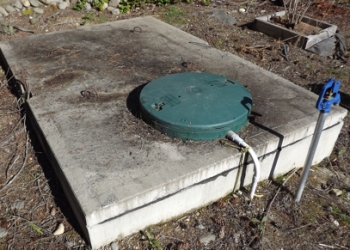
Well experts will tell you that a well head is sealed, and there is virtually no way for a private water system to get contaminated from the well itself. It is a “closed system” as they say. As long as the aquifer deep below the surface is not polluted from a nearby source of industrial contamination, which we don’t have in the Sequim valley anywhere that I can recall, there is no possibility of contamination. This is good news, unless you own a well that was installed prior to 1985. Prior to 1985, believe it or not, well heads were not sealed. In the photo above you can see an example of a well that is pre-1985, and the well cap did not have a rubber seal of any kind. While the cap was bolted securely on the well head, it still was not perfectly sealed, and tiny ants got in this well. This was so rare, even the well drilling company had never heard of this happening. It was not a major issue, because the owner simply ran the hose and the faucets in the house, and the ants got washed out of the system. A water sample was taken and no nitrates or bacteria were found, but to be safe the well was “shocked,” meaning that Chlorine crystals were dropped in the well. Of course, a rubber seal was installed, and the well cap put back in place.
I’ve written two other articles on private wells for your edification, including Sequim Private Wells and Well Logs and Sequim Well Inspections. If you’re buying a lot or a home with a private well, understanding the issues of private wells is an important part of your due diligence.
Possibly Related Posts:
20 Feb
If you buy a Sequim home or a Port Angeles home with a private well, you’ll want to do your due diligence and review the well log originally filed with the county. There are two important numbers–the flow rate (gallons per minute) and the well depth (and the depth of the water within the well). I’ll give you the link to all well logs in the State of Washington, which are online with free access. Here is how I briefly interpreted one well log for a client:
You’ll notice a couple of key numbers on the report. The depth of 110 feet, and 35 gallons per minute! Most wells around here are 8 to 12 gallons per minute, some are 15 or even 17 (I’ve seen many in the 20s), but you only need two or three gallons (I’ve also heard 4 or 5 gallons) per minute to have plenty of water for household use. 35 gallons per minute is very rare and enough for a community well for a dozen houses. So, congratulations! It appears you have one of the highest flowing wells in the entire county.
You can see view wells logs in the area and around Sequim by going to a well log map search at:
http://apps.ecy.wa.gov/welllog/
I always thought it was strange that on well logs, which are completed by the well driller, they rarely include a street address. The true identification of the well is by a tag number on the well itself, which is also written in the upper right corner of the well log. As a practical matter, most wells are drilled before a house is built and so there is no official street address. Sometimes it’s hard to figure out which well log is your well log when searching on the above link. Search by street address, and if that doesn’t work, search by well owner, and if you don’t know the original well owner’s name or no results appear, you might have to try the tax ID number, which you can get from another county website at Clallam County Tax ID Numbers. If you still can’t fine it, do what I do. I just pull up the map and zoom in on the area and then I click on the wells that seem closest to the property. Usually when you click on one of these well locations, many well logs pop up, and then you can browse through these to find yours.
This is a great tool on the Internet, and like everyone else, I love the fact that access is free.
Possibly Related Posts:
8 Jan
Did you know you could purchase a lot or vacant land that cannot produce drinking water? Did you know that you could purchase a home with a private well that dries up part of the year, or has a low water flow? Imagine having to haul drinking water and having to install a storage tank for all your residential water use! It’s a nightmare, but it happens!The vast majority of private wells produce excellent water flow and excellent quality on the Northern Olympic Peninsula. We are very fortunate that way. But you only have to be one in 1,000 who end up with a well problem to make it your personal nightmare. How can you protect yourself?
As with all things real estate, due diligence is important. Jennifer Henderson of Canal Pumps in Sequim, Washington, said the red flags are things like a well log that indicates low water flow, or a well log indicating a dry well, or well logs in the same area that indicate such problems or multiple wells drilled on the same property.
How in the world do you get the well logs for the general area that you are interested in? Good news! There is a beautiful website with just that information maintained by the Washington Department of Ecology, and it has Sequim Well Logs and Port Angeles Well Logs. You can use an online map to identify where you want to look, and you can zoom in on your specific area. All the wells that have been drilled will show up on the map, and you simply click on the red dot representing a well, and the entire well log is instantly available.
Of course you can also call local well drillers, who typically will know the troublesome areas and can advise you appropriately. Due diligence is always good. Working with professionals who can help you avoid Traps for the Unwary is always good. Saving money and stress are definitely good.
Possibly Related Posts: