
Welcome to Sequim & Port Angeles Real Estate, LLC
19 Apr
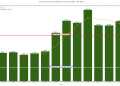
Sequim real estate sales in the first quarter of 2012 are an indication of whether the Sequim real estate market is recovering or still on hold. The national real estate market is showing some signs of recovery according to the National Association or Realtors Chief Economist, Lawrence Yun. Since many of our buyers are retirees who must sell their homes in other states, this is relevant. Here is a chart showing Sequim real estate sales in the first three months of the year from 2005 (our peak year) to 2012.
As shown in this graph, the last three years have been pretty even, 81 homes sold in Sequim in 2010, 76 homes in 2011, and this year 72 homes.
Here is the positive news from the NAR Economist.
Existing-home sales were down in March but continue to outpace year-ago levels, while inventory tightened and home prices are showing further signs of stabilizing, according to the National Association of Realtors. Total existing-home sales, which are completed transactions that include single-family homes, townhomes, condominiums and co-ops, declined 2.6 percent to a seasonally adjusted annual rate of 4.48 million in March from an upwardly revised 4.60 million in February, but are 5.2 percent above the 4.26 million-unit pace in March 2011.
Lawrence Yun said the recovery is in the process of settling into a higher level of home sales. “The recovery is happening though not at a breakout pace, but we have seen nine consecutive months of year-over-year sales increases,” he said. “Existing-home sales are moving up and down in a fairly narrow range that is well above the level of activity during the first half of last year. With job growth, low interest rates, bargain home prices and an improving economy, the pent-up demand is coming to market and we expect housing to be notably better this year.”
Also on a national level, total housing inventory at the end of March declined 1.3 percent to 2.37 million existing homes available for sale, which represents a 6.3-month supply2 at the current sales pace, the same as in February. Listed inventory is 21.8 percent below a year ago and well below the record of 4.04 million in July 2007.
“We were expecting a seasonal increase in home listings, but a lack of inventory has suddenly become an issue in several markets with not enough homes for sale in relation to buyer interest,” Yun said. “Home sales could be held back because of supply factors and not by demand – we’re already seeing this in the Western states and in South Florida.”
The national median existing-home price3 for all housing types was $163,800 in March, up 2.5 percent from March 2011. Distressed homes4 – foreclosures and short sales sold at deep discounts – accounted for 29 percent of March sales (18 percent were foreclosures and 11 percent were short sales), compared with 34 percent in February and 40 percent in March 2011.
Foreclosures typically sold for an average 19 percent below market price in March across the U.S., while short sales were discounted 16 percent.
Sequim real estate sales do not track national sales precisely, and I’ve written that the Sequim real estate market is shielded to some extent from the national market, but we’re clearly still impacted.
Possibly Related Posts:
5 Apr
Is the housing market recovering or not? This has been a topic of conversation for several years now, and we are still discussing it. Many retirees have told me that they don’t know if real estate prices are at a bottom, but even if they are not, they intend to live in their retirement homes for the next 10 to 20 plus years, so it doesn’t matter. Still, we all want to invest wisely, so let’s look at the real estate market and what the future may hold.
Chief Economist of IHS, Inc. (Information Handling Services) Nigel Gault, said yesterday (4/4/12) that the massive student loan default of so many young Americans will have a negative impact on housing, because so many young buyers will not be able to purchase homes as a result of their student loan defaults. Most of us have not given the student loan default issue much thought, at least as it may relate to the housing market and demand, but the past due amount is now $85 billion dollars. That’s not chump change.
Gault said that the already slow housing recovery will be longer because of these student debts which will translate into many buyers unable to buy a home. As this graph shows, student loan defaults have effected several age groups with the largest group (34.2%) being in the 30 to 39 age group. Those under 30 years of age make up 25% of the student defaults. These people will most likely not qualify for a home loan because of their defaults.
Another factor that Gault did not mention, but I see as a very large variable, is that this recession with all the young people who are out of work is destroying the credit scores for millions of young people who one day hope to buy a home. If you combine a low credit score with tighter appraisal standards, higher loan standards, and higher down payment requirements, it is highly probable that young people who would otherwise have purchased homes in the next few years will not be able to.
Gault also pointed out that many young people are living at home with parents during this recession, and over the next few years many will be forced to rent rather than buy. All of this will impact the real estate market because there will be less buyers, at least less young buyers. That will hurt sellers most of all, and only create a stronger buyer’s market, as if it wasn’t already a buyer’s market.
How will this effect the Sequim housing market? Buyers in the Sequim housing market are primarily retirees (perhaps 95%), so for the most part the student defaults will have little effect on buyers in our housing market. However, for those retirees who are unable to sell their homes in other states because there are fewer young buyers, including those who must sell an existing home before they can buy a home in Sequim, then some sales will be lost in Sequim.
Many retirees have told me that the time for them to move to Sequim and buy a home is now, and the state of the economy and the real estate market are only two factors in their decision making process. Many have told me they feel prices are at or near a bottom, and that interest rates are also bound to go up from here. They are right about interest rates. We were recently at a 50 year low when the 30 year fixed mortgage rate was under 4%, and this morning it is already up to 4.25%. An increase in interest rates will increase both qualification requirements for buyers as well as the monthly mortgage payment.
The housing market is a long way from recovering, but fortunately the Sequim housing market is much more stable than most areas of the country and our buyers are strong qualified buyers.
Possibly Related Posts:
4 Dec
This real estate market has two dramatically different outcomes for people today. The two outcomes depend on which group you’re in. The first group includes homeowners who are getting hurt in this real estate market. The second group consists of homeowners and buyers who have a rare opportunity.
The largest percentage of homeowners in history will be those getting hurt in this real estate market. There are several reasons. Many overextended themselves on their mortgages, no thanks to the government programs and the greed in the mortgage industry that pushed mortgages on average Americans without income qualifications and with reckless disregard for ability to make the mortgage payments. While each of us bears responsibility for our own decisions, this mortgage debacle has resulted in more foreclosures and middle class Americans loosing their homes than any other time in our history.
Compounding this crisis is the economic recession with the total unemployment and underemployment rate at 16.6%. [See Real Unemployment Rate] Don’t believe the economists who says we are not in a recession. We are, and it’s been devastating for middle class Americans who are homeowners in this real estate recession. The loss of jobs by one or both spouses, or the reduced hours and compensation means they can’t make their mortgage payments, and because this real estate recession has put so many homes underwater (they owe more than the home is worth), they cannot sell their homes either. Middle class Americans are losing the equity in their homes in this real estate market, and their credit will be destroyed for the next decade. Their savings have dwindled to nothing while they try to make ends meet, and their credit cards are maxed out, resulting in further damage to their credit. Millions of these good Americans have collection agencies hounding them daily, and many have judgments already entered against them, also accruing interest at 12% (the legal rate), and these judgments will follow them for seven years, unless they are re-registered, in which case the nightmare continues.
These are difficult times, and sad times for so many families.
The winners in this real estate market will be those who do have good incomes, good credit scores, and cash to pay 20% or more down on a home. Fortunately, there are many retirees who fall into this group. There is also a very small percentage of young families who have high paying jobs and also fall into this group of winners. Why are they winners? Because they will be the small percentage of buyers in this real estate market who can afford to buy homes at the best prices in years and at the lowest historical interest rates. If you are a buyer when everyone else is a seller, you end up the winner. This is an economic reality.
There’s nothing you or I can do individually to change all of this on a macro-econcomic level. On a micro-economic level, however, each of us must take responsibility for our own financial futures. You and I cannot save the millions of families losing their homes or struggling without a job, but we can do something about own own futures. It makes sense to manage your financial future with conservative planning and with wisdom. Right now the application is to take advantage of this real estate market to take care of your own future. After all, before you can help anyone else, you have to be able to help yourself. This is a time to buy carefully at the right price. This is definitely a buyer’s market in this real estate market and in this recession. As I’ve written elsewhere, distinguish the market from the house. The real estate market is down but don’t buy the market. Buy one house in the right area at the right price, and that’s how you win in this real estate market.
Possibly Related Posts:
21 Nov
Buyers have been asking, “Are we at a market bottom? Are real estate prices stablized or are they going down more?” No buyer wants to pay too much for a home, so these are intelligent questions any discerning retiree is going to ask. But these questions have been relevant for a couple of years, and to this date no one has been able to call a market bottom or “time the market.” Here are my thoughts on why no one has been able to call a market bottom.

In the context of investing in the stock market, there are those who claim that you cannot “time the market,” and these are the financial advisers who recommend investing for the long term. Long term fund managers and financial advisers rely primarily on fundamental analysis. On the other hand, it cannot be denied that there are many who have become very wealthy by “timing the market” by buying and selling at the right times, or at least often enough to come out very profitably. These folks tend to rely more on technical analysis by reading charts. Their argument is that a chart represents all investment variables and that’s why chart patterns have meaning. Market timing, whether it is in stocks, options, or commodities, is not a game for the feint of heart. If you want a stressful two hours, try flipping volatile options in a wild market.
Real estate does not have as many players jumping in and out of the market every hour (or every second) of every day like the stock market, and you would think that identifying a market pattern or a market bottom would not be so complicated in the real estate market. But no one has been able to call a market bottom. I have been very cautious and have not called a market bottom, and here is why. There are several key elements to accurately predicting a market bottom, and if you have credible information on a majority of these elements, you can draw some intelligent conclusions regarding the market. Right now there are key elements that are still wildly unpredictable. Consider these totally unpredictable events that are major determinants in accurately predicting when we will be at a market bottom in real estate prices. I’ll start with the big picture and drill down to our local market. (more…)
Possibly Related Posts:
4 Sep
Sequim Washington Magazine is a new and exciting publication specifically designed, written and published for retirees from out of state. Many people know all about Sequim and have been planning to retire for many years in Sequim. But many others who are near retirement don’t know about the Blue Hole or the Rain Shadow, or they don’t know about the amazing Sequim lifestyle, or the recreation, the fishing, the golfing, the kayaking, or the incredible retiree population here. Many still do not know what it is like to live on the gorgeous Olympic Peninsula just two hours plus from Seattle or SeaTac. There are so many reasons Sequim is an incredible place to live, and the climate and the fact that we get one-third the rainfall of Seattle are good reasons, but there are many more. Sequim Washington Magazine is one way the publisher wants to spread the good news about Sequim.
This is not a typical magazine. Not at all. Sequim Washington Magazine is a single publication that will evolve and grow. Articles and relevant contact, photos, videos, and local stories will be added, but rarely deleted. It will not be a typical magazine that changes completely with every issue. This magazine is intended to be the best source of information, photos, and vidoes on Sequim, and that means we will grow, almost like a living and breathing publication.
Notice that throughout the magazine there will be links to local sites and information, and if you click on the link, which may be embedded in a photo or within an article, you will be taken to that site. Sequim Washington Magazine can be opened up into a full screen magazine.
Who writes this magazine and who takes the photos, videos, and who publishes it? Why of course, it is yours truly–Chuck Marunde. This is another way I try to share the good news about Sequim with all the potential retirees around the country who are looking at Sequim and want to learn more. Having lived in Sequim for 18 years now and having raised my own family here, I can personally testify to what an incredible and wonderful place Sequim is. I often walk outside and say what I said again today, “Another day in paradise!” I hope you enjoy Sequim Washington Magazine and your suggestions for articles will be welcome.
If you like the magazine, may I suggest and encourage you to email a link to friends or family who might enjoy it? And anyone who lives in Sequim or is planning to move to Sequim is welcome to submit their own article or testimony. I’m certain others would love to hear and learn more from recent converts or long-time residents.
Sequim Washington Magazine – brought to you by Chuck Marunde.
Possibly Related Posts:
22 Aug
The housing market is both strong and weak, and that’s not so much of a play on words as you may think. The majority of the real estate market is in the tank almost everywhere in the United States. Vast numbers of homes in this housing market have been in the MLS for a long time, some for two or three years or more. This is the segment of the housing market that we read about on the front pages and hear about on the T.V. news. It is full of homes people cannot sell, homes that buyers do not want or cannot finance, and includes foreclosures. This is the segment that is weak.
I just spent the weekend in Las Vegas, and my interest in the condition of the housing market prompted me to talk at length with a local Realtor about the housing market. I spoke with Aubrey Buck, a top producer who will close a dozen transactions this month alone. Here is what I learned.
The Vegas market is surprisingly similar to Sequim, Washington. Here’s is what I mean. Both markets have a large percentage of homes that have not been selling within a reasonable period of time. Both markets have fewer buyers than in years past. Both markets have seen substantial discounts in the prices of homes. But here is where the similarity is fascinating: Both markets have a small segment of the market that is selling quite well and within a reasonable period of time and for good prices. This is the segment of the market that is strong.
In this recession, and especially in Las Vegas where the media reminds us constantly that the housing market is in shambles, Aubrey Buck is selling houses as fast as she can, and that means selling three homes every week. Aubrey is selling the best homes in the best areas for the best prices, and for these homes there are more buyers than she has time for. Believe it or not, but Aubrey told me that she doesn’t have time to put up signs on her listings, because they get sold within a few days. That’s not happening in Sequim, but retirees are planning many months in advance before they arrive in Sequim to look at homes. So even the ideal home in Sequim listed at a great price may be on the market for a few months before prospective buyers get to view it.
Who are the buyers for Aubrey’s homes? They are investors who realize this is the best time to buy in years with prices dragging bottom and with historically low investor interest rates. They are also first time home buyers, which we don’t have in Sequim, and they are upper income buyers moving to Vegas.
The Sequim housing market has a similar pattern, and I’ve been writing about this for over a year. The best homes in the best areas are selling for reasonable prices, while the majority of the housing market in Sequim sits on the market waiting for a buyer who never comes. The challenge for retirees is that the small number of ideal homes that almost all retirees tend to focus on are selling, and when they are sold, they are off the market forever. As these better homes are removed from the MLS inventory, that leaves the larger percentage of homes that no one wants. This is why retirees are making their move this summer in Sequim to buy a home. They also believe interest rates are going to go up.
Sequim does not have investors buying homes, certainly not in any significant numbers. Sequim also does not have a market for first time home buyers. The Sequim housing market is almost entirely retirees, who are largely looking for similar homes.
Possibly Related Posts: