Welcome to Sequim & Port Angeles Real Estate, a Branch Office of Adamas Realty
28 Sep
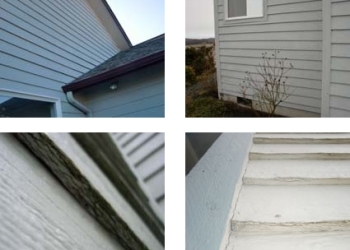
You will want to order a home inspection as part of the due diligence you are doing when you buy a home. Tyler Conkle is a local Home Inspector who contributed this article on LP Siding. Suppose your home inspector has informed you that the exterior siding of the home has deteriorating LP. What does that mean and what should you do next?
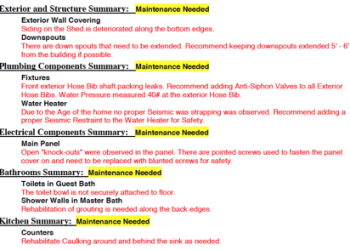
The home inspection report should have some accompanying photos and may read something similar to this:
Some manufacturers specifications state that if the leading edges of the lap siding had expanded to 5/8 of an inch or greater, failure occurred in that area. There may not be extensive damage or obvious evidence of deterioration that would result in removing and replacing all or even portions of the siding, but that is why you hired a qualified inspector. The majority of the siding may still be functional, and yet in need of extensive maintenance in order to arrest the deterioration and preserve the integrity of the materials. (more…)
Possibly Related Posts:
27 Aug
Are private wells safe? My clients often ask this question, and it’s a good question, especially if you’ve never had a private well before and you’ve always been on a public water supply. Private wells are safer than public water systems in some ways and not as safe in other ways. I’ll explain what I mean.
We are very fortunate that Sequim private wells generally have very good water, clean and pure. Wells are typically 50 to 80 feet deep with water at 30 or 40 feet, and water flows of 8 to 20 gallons per minute produce more water than a family can use. There are a few wells in the valley on the side of a mountain where water was not reached or where there is a lot of iron in the water (in the Blyn area). Otherwise, private wells produce plenty of pure drinking water.
One of the drawbacks to using a public water system is that it is subject to pollution. That is rare, but it has happened. The more likely health hazard using public drinking water is the high levels of Chlorine they use. I once heard the statement, “You don’t want to drink public water without Chlorine to kill contaminants, but you certainly don’t want to put all that Chlorine into your body.” If you have a private well, you can keep your well pure without these concerns.
Well experts will tell you that a well head is sealed, and there is virtually no way for a private water system to get contaminated from the well itself. It is a “closed system” as they say. As long as the aquifer deep below the surface is not polluted from a nearby source of industrial contamination, which we don’t have in the Sequim valley anywhere that I can recall, there is no possibility of contamination. This is good news, unless you own a well that was installed prior to 1985. Prior to 1985, believe it or not, well heads were not sealed. In the photo above you can see an example of a well that is pre-1985, and the well cap did not have a rubber seal of any kind. While the cap was bolted securely on the well head, it still was not perfectly sealed, and tiny ants got in this well. This was so rare, even the well drilling company had never heard of this happening. It was not a major issue, because the owner simply ran the hose and the faucets in the house, and the ants got washed out of the system. A water sample was taken and no nitrates or bacteria were found, but to be safe the well was “shocked,” meaning that Chlorine crystals were dropped in the well. Of course, a rubber seal was installed, and the well cap put back in place.
I’ve written two other articles on private wells for your edification, including Sequim Private Wells and Well Logs and Sequim Well Inspections. If you’re buying a lot or a home with a private well, understanding the issues of private wells is an important part of your due diligence.
Possibly Related Posts:
29 Nov
I recommend all my buyers have a Sequim home inspection completed as one of the contingencies of buying a home in Sequim. You can do your own Sequim home inspection if you are an expert in construction, heating and circulation systems, wells and septics, electrical, foundations, roofing, siding, appliances, and so on, but most of my buyers are not. It makes sense, in my opinion, to hire a local expert who has inspected hundreds of homes in the area and who knows the potential red flags that will protect you from buying a home with a serious defect.
This morning I will attend a home inspection with a client from California. As a Sequim Buyer’s Agent, I like to attend inspections with my clients when possible, but especially when they cannot be here. This is a three bedroom single level home in a very nice neighborhood with a peaceful view of farmers’ fields from the back yard and a sweet view of the Olympic Mountains. This is a beautiful home with great curb appeal, and this is all the more reason to have a detailed Sequim home inspection done by an expert. If there are issues of any kind that are not visible, but could be expensive problems to repair later, my clients need to know now so they can have the seller take care of the problem or negotiate a reduction in the price they already agreed upon.
A Sequim home inspection will typically cost from $350 to $450, a price well worth the information and protection in my opinion. As a buyer, you pay this cost, normally directly to your Sequim home inspector. While a home inspection is not a guarantee, it is a form of insurance so you won’t be surprised with a problem that could or should have been caught before you close your purchase.
In this photo Tyler Conkle explains what he looks for in the electrical system during a Sequim home inspection.
Possibly Related Posts:
15 Sep
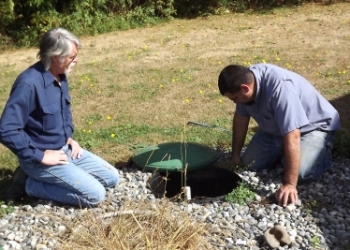
Sequim septic inspector and designer Eric Hibbard conducted a septic inspection on this home just sold between Sequim and Port Angeles. This home is a new manufactured home built with high quality and custom options, which makes it a “cut above” many stick built homes that were built by discount home builders in the area. This home also sits on 1.25 acres in an area of similar sized lots, and has a view of the mountains to the south. There actually is a small water view looking out the dining room window and kitchen window to the south.
Buying a home in a rural area outside the Public Utility District means having your own well and your own private septic system inspected prior to closing. A septic inspection is not complicated or expensive, but you really need a Sequim septic inspector who is licensed and certified to do that job. There are stringent requirements for septic systems, and it is fairly well known that the laws now require systems that are designed to far exceed the standards needed. All the more reason to hire a Sequim septic inspector to be sure the home you’re buying is up to the legal standards and that there are no problems lurking in dark places.
One assumption home buyers sometimes make is that all septic systems should be pumped by the seller before closing. According to Eric Hibbard, that is not true. If a septic tank is pumped too early, the bacterial action necessary to break down contents will be interrupted, and the septic system will not operate at peak efficiency. After measuring the level of solids and liquids in this system, Eric recommended the system not be pumped. It was operating perfectly.
Our Sequim septic inspector also examines the drain field to make sure it is working properly. A system permitted for two bedrooms will have a drainfield that is 100 feet long, and you add 50 feet to the drainfield for each additional bedroom.
There’s a good reason to keep Eric Hibbard’s contact information in your rolodex (does anyone still use a rolodex?), because the law now requires an annual septic certification by a certified inspector. It’s a pain, but it needs to be done to comply with the law, although there is no code enforcer on this requirement. Should you need an annual inspection, I do recommend Eric, because he is not only licensed and certified, he is also very knowledgeable and professional.
Eric Hibbard, can be reached at Soils Application in Carlsbord (between Sequim and Port Angeles) at 360-683-6300, your friendly Sequim septic inspector.
Possibly Related Posts:
1 Mar
As a Home Inspector I am involved in continuing education. Keeping up-to-date with current building practices, changes in standards and unfortunately, sometimes product defects and re-calls that affect the inspection industry is a full time occupation. I am often asked questions concerning the reputation of not only the builders, but of the quality and types of the building materials being used in the construction of newer homes and attached decks and balconies. Although the majority of our local contractors are in the business of quality workmanship when building or renovating homes, they are still subject to the possibility of having used less than superior or even acceptable materials.
Some manufacturers are responding to distributor’s, wholesaler’s, retailer’s and customer’s complaints by issuing alerts and warnings of product deterioration and failure. Installing the decking to meet each particular manufacturer’s specifications is paramount in complying with warranty guidelines and restrictions. Taking a moment to look over the following information could help your clients better understand that even using the most currently advertised materials is no guarantee that problems will not develop in the future. It is my job as an inspector to carefully relay any applicable information, based on the visible conditions observed at the time of inspection that may impact the life expectancy of the decking materials that were used in both new construction and renovated decks and balconies.
Possibly Related Posts:
19 Feb
When you buy a home, it is wise to have a septic system inspection unless you are on a public sewer system. A septic system consists of a tank and a drainfield. The tank holds the solids and the liquids overflow into the drainfield and are dissipated. In our Washington real estate forms and “Septic Addendum,” it is the seller’s responsibility to have the septic system inspected. The temptation of some buyers is to require a seller to pump the septic system, but that could actually cause damage to the system.
According to Jerry Jacobs shown in this photo inspecting a Sequim septic system, a tank should not be pumped unless it has 30% or more of solids in the tank. In a standard sized tank of 1,000 gallons, that would be 18 inches or more of solids. Why wouldn’t you automatically pump a tank clean even though it has less than 30% of solids? A septic system needs bacteria to work. The waste water separates into layers in the septic tank. This is where the process of decomposition begins. Bacteria, which are naturally present in all septic systems, begin to digest the solids that have settled to the bottom of the tank, transforming up to 50 percent of these solids into liquids and gases. If you pump a tank too early or too often, you inhibit the bacteria building and decomposition process.
Septic systems can last for years, but if not maintained properly, you could end up with a hefty expense some day. Here are a few important tips to make your septic system last forever. By the way, if you are a retired couple and don’t have a lot of company staying with you, you probably won’t have to have your septic tank pumped for many years.
A special thanks to Jerry Jacobs for sharing his wisdom with this author.
Possibly Related Posts: